Interview on history
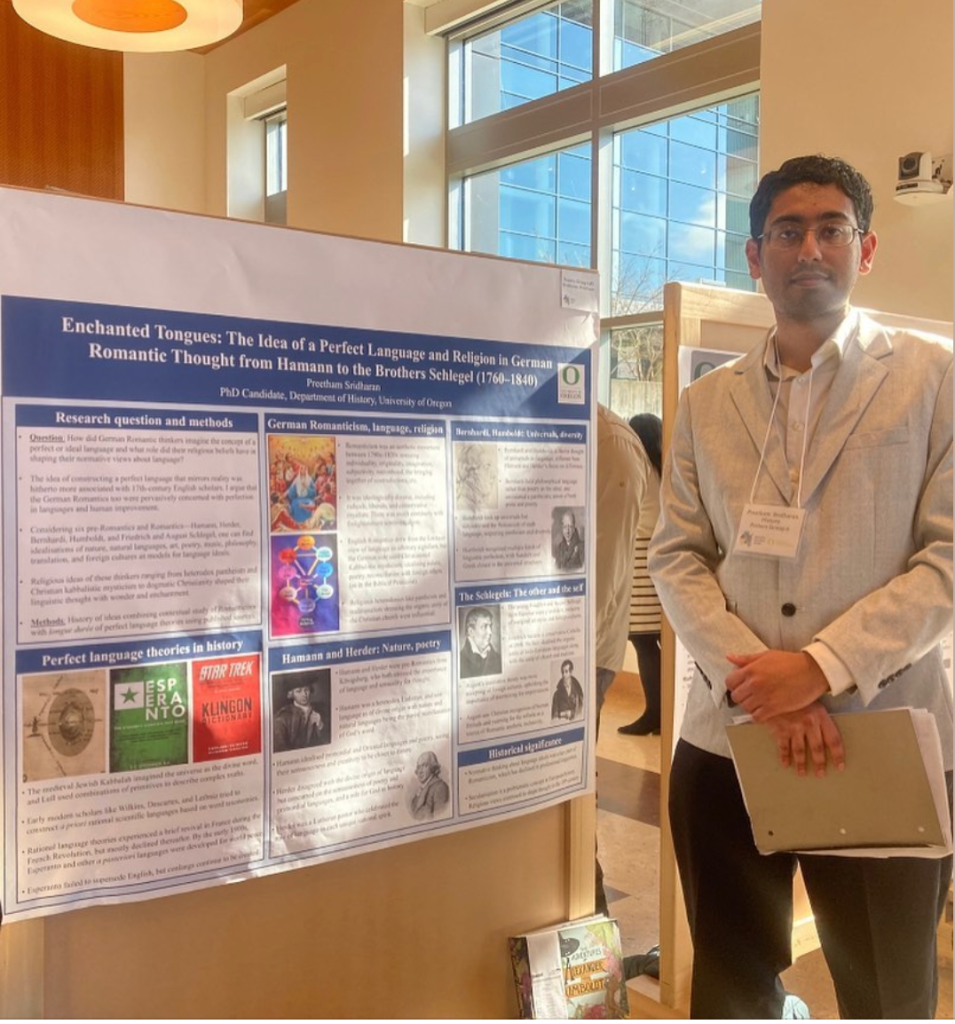
Tell us a bit about yourself.
Hi everyone! I’m Preetham and I’m currently in the sixth year of the PhD programme at the UO. I am from India, from the southern state of Tamil Nadu, and I focus on German intellectual and religious history in the eighteenth and nineteenth centuries. I’m presently writing my dissertation relating histories of theories of perfecting languages with theological thought. My research area might sound specific, but I have a lot of diverse interests as well, both within and outside academia. I’m fascinated by learning new languages and I’m glad to have been able to learn German in addition to my native language of Tamil and English. My other interests are in knowing more about computer technology, cooking, and reading. I used to write some poetry in earlier years, but I haven’t kept up with it nowadays, unfortunately!
What brought you to the field of history and what influences impacted your scholarly interests?
I was interested in history right from my school years in India, as my grandparents were also secondary school teachers who taught social studies. However, in my millennial generation in India in the 1990s and early 2000s, it was not a common career path to study history in university. I was unsure at first how to pursue my interests as my school education focused on the STEM fields and economics/business, and there was no option for history. I taught English as a second language in India, which was an experience that greatly increased my curiosity for learning more about history. Eventually, I ended up doing the MA programme in history at Portland State University in Oregon. I have also done some language study in Germany. One of my main reasons for studying intellectual history especially was that I believe studying the history of older ideas is not merely an antiquarian endeavour, but can expand our imagination by helping us recover older ideas that could be valuable for human improvement in the present day. Many academic disciplines tend to be presentist in their approaches nowadays, but I’m hoping to use my research in the histories of fields like linguistics and religious studies to broaden our conversation about what constitutes knowledge by including past developments.
What brought you to the University of Oregon and what have you enjoyed most about the department?
After completing my MA thesis, I was hoping for a way I could continue to deepen my knowledge of working with old texts, and I was very glad to be accepted to study here at the UO. My advisors Professors John McCole and Ian McNeely have been fascinating to work with all these years, and my most favourite part is that they encouraged me to pursue my own interests in researching intellectual history rather than making me follow a prescribed path. It made me feel empowered and confident to take risks and craft an approach that best suited my ambitions. I also appreciate all the conversations and encouragement from my colleagues during my time here, and the opportunity to get a GE position in religious studies to fund my dissertation research.
How does the development and usage of language impact the field of history?
Growing up in India, multilingualism was very much part of our daily life, and I have found it very enriching to learn new languages and immerse oneself in the culture of a different people. My native language Tamil is a minority language in several countries like India, Sri Lanka, and Singapore, but it is unfortunately hard to find opportunities to pursue advanced studies in the language and its history due to institutional support problems. In future, I hope I can also relate my studies in German intellectual history to include my native language and its history in a more substantial manner. I think it would be good to balance both one’s native culture and learning about other world cultures. History involves work with textual sources and is heavily dependent on linguistic competence of historians. It is important to make the discipline more representative of the diversity of world cultures and languages.
What words of wisdom do you have for current, or speculative, history majors and graduate students?
I believe it can be good for history students to take courses in several different time periods and world regions to enhance their understanding of diverse disciplinary methodologies. There are much fewer classes that are available in pre-modern histories, but they can be very useful to broaden perspectives. History graduate students could also take advantage of numerous other departments here that offer courses related to history. Everyone’s path here is different, but we all benefit from our shared experiences together as a department.
 Preetham Sridharan's website