HIST 302: Nineteenth-Century Europe
Summer Session II (July 22nd–August 18th, 2024)
4 credits, online asynchronous (CRN: 40895)
Instructor: Preetham Sridharan (he/him/his)
Course delivery method: Online asynchronous; no set meeting-times
Office: McKenzie Hall 340P
Zoom office hours: Mondays and Thursdays 10am–12pm
Email: preetham@uoregon.edu
Phone: 732-585-3006
Click here for History 302 Summer Course Poster (Nineteenth-Century Europe)
Click here for Film list about nineteenth-century Europe
Course Description
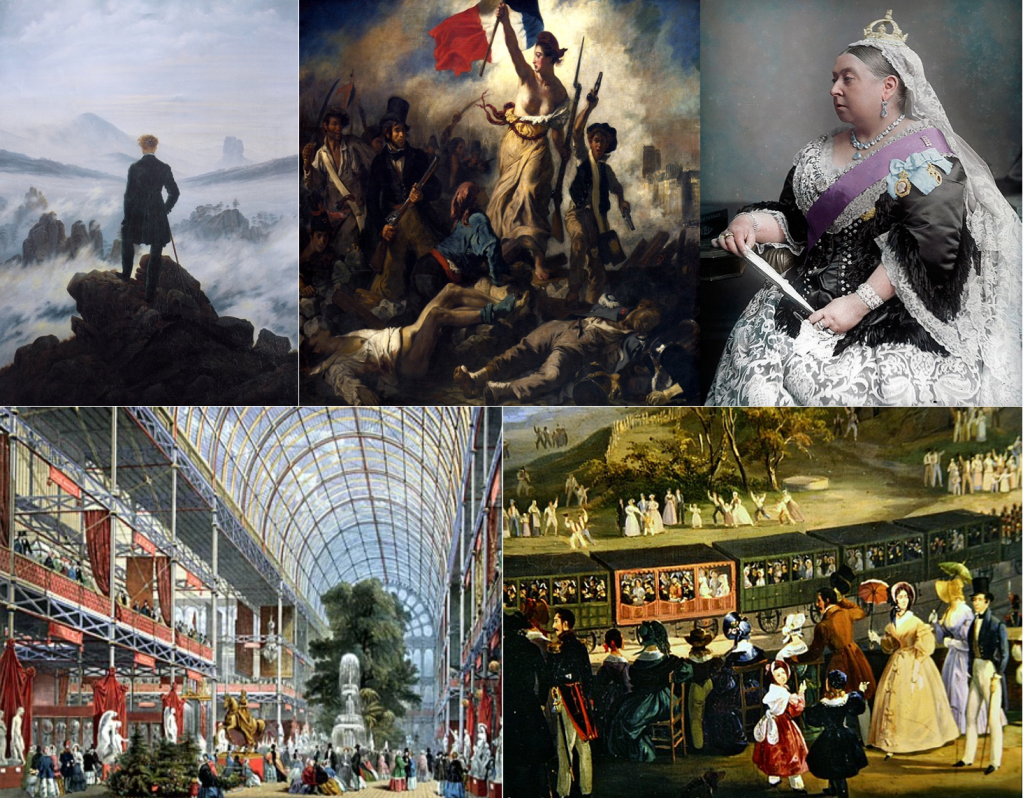
The historian Eric Hobsbawm divided the long nineteenth century in Europe into three parts: the “age of revolution” (1789–1848), the “age of capital” (1848–75), and the “age of empire” (1875–1914). The dramatic political and economic transformations of this period led many to conclude that they were living in a period vastly different from all previous ones. Yet, the philosopher Michel Foucault called the period as the “age of history,” a period that could never stop being fascinated and haunted by its own past. How would you make sense of such a dynamic and yet troubling period? How did Europeans of different regions, nations, religions, ethnicities, and genders experience these changes? What did Europe mean to colonised peoples across the world?
To study the complex history of the nineteenth century, we will consider the key political, socio-economic, cultural, and intellectual developments in this period between the French Revolution and World War I. We will use a combination of video lectures, primary and secondary source readings, and written assignments. Towards the end of the course, there will be an optional film analysis final project that students might choose to do in lieu of the take-home final exam. This project will be helpful as a starting point for future research about the nineteenth century, and as perhaps a public history project critically examining popular representations of the past. Students who wish to take the final exam are welcome to do so.
Our course will cover traditionally important topics in European history such as the French Revolution and its legacy, industrialisation and agrarian reform, the Revolutions of 1848, the unifications of Italy and Germany, European imperialism, mass politics, the origins of World War I, and various artistic and cultural movements. However, we will also incorporate new perspectives and topics that speak to current issues in Europe and the world today, including themes like democracy, capitalism, science, religion, race, gender, and sexuality
Learning Objectives
- To become familiar with the major political, socio-economic, and cultural events of nineteenth-century Europe and its relationship with the rest of the world.
- To understand the key debates in the historiography of this period in Europe and discuss how historians approach this era.
- To read both primary and secondary sources about a variety of themes pertaining to the period, including some that relate to present-day events.
- To write both analytical essays about particular primary sources/films and synthetic essays that bring together large periods of history.
- To communicate effectively with others about historical topics in an academic setting.
Assigned Books
The following three books are required. The UO library has purchased e-books for the Karl Marx and Miles Taylor books that are available free-of-cost at the following links. The Rapport book, however, needs to be purchased. Additional readings are uploaded on Canvas.
- Michael Rapport, Nineteenth-Century Europe (Palgrave Macmillan, 2005)
- Karl Marx, Selected Writings (Hackett Publishing Company, 1994)
3. Miles Taylor, Empress: Queen Victoria and India (Yale University Press, 2018)
Course Canvas Site
We will use this site for course modules, additional readings beyond the three textbooks, assignment submissions, and grade records. You can also access my Zoom office hours using the links on this site. I encourage you to use the Canvas mail to contact me during the term. I will communicate with you regularly and provide written feedback on assignments.
Assignments and Grading
Your final course grade will be based on the following components:
| Assignments | Grade percentage | Due Dates (by 11:59pm) |
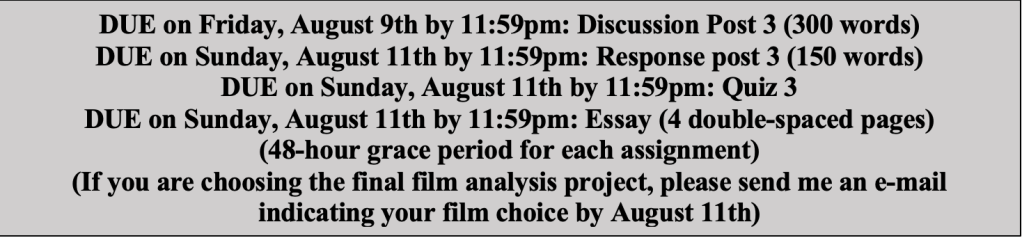
| Three 300-word Canvas Discussion Posts (and three 150-word responses to classmates’ posts) | 20% | Friday, July 26th Sunday, July 28th (Response) Friday, August 2nd Sunday August 4th (Response) Friday, August 9th Sunday, August 11th (Response) |
| Four weekly comprehension quizzes (10 multiple-choice questions each) (2 attempts allowed) | 10% | Sunday, July 28th (Quiz 1) Sunday, August 4th (Quiz 2) Sunday, August 11th (Quiz 3) Sunday, August 18th (Quiz 4) |
| Take-home midterm exam | 20% | Sunday, August 4th |
| Essay (4-pages) | 25% | Sunday, August 11th |
| Final film analysis essay (5 pages) or take-home final exam | 25% | Sunday, August 18th |
There is a 48-hour grace period for all the assignments except the final project/exam and quiz 4. You may submit these assignments without penalty for up to 2 days after the due date.
You will be asked to do a brief introduction post on Canvas during week 1. This post is not graded, but will be due by Sunday, July 28th at 11:59pm.
The three 300-word Canvas discussion posts will be due on Fridays of weeks 1–3 (July 26th, August 2nd, and August 9th by 11:59pm). Other students can view your responses too. They are meant to share your insights with the rest of the class. You will also need to post one substantive response (minimum 150 words) to any one of your classmates’ posts during each of these weeks. The 150-word response posts should be posted by the Sundays of weeks 1–3 by 11:59pm. Questions will be provided in advance every week. There is no discussion post assignment during week 4, so that you have more time to complete the final project/exam.
The weekly comprehension quizzes are meant to help you review the week’s readings and lectures, and make sure that you are getting all the main points. They are open-book and you will have eight multiple-choice questions. The quizzes are untimed and you will have two attempts overall. They are also due every Sunday night, but note that quiz 4 will not have a grace period as August 18th is the last day of class.
All other longer assignments will be due on Sundays by 11:59pm. Please make sure to plan ahead with these assignments as they carry a lot of percentage points. The grace period applies to all these assignments except the final project/exam.
The 4-page (double-spaced) essay assignment is due at the end of week 3. The due date is August 11th by 11:59pm. This essay will be about Miles Taylor’s biographical work on Queen Victoria in relation to other course readings.
The midterm exam will be due on the Sunday at the end of week 2 (August 4th) by 11:59pm. It will consist of two quote identification questions and one take-home essay. The exam is not timed, and you can complete the essays at your own pace. The midterm essay should ideally be about 3 double-spaced pages in length.
There will be a choice between a final film analysis project and a final exam for this course. If you choose to do the film analysis project, please watch and analyse one or two historical films about the nineteenth century. You will critically reflect on the representation of the period/events/persons/themes in the film, and connect it to at least two course readings. A list of films and more details will be provided soon during the course. You may also choose to work on films that are not on the list after consultation with the instructor. The film analysis essay should be about 5 double-spaced pages. If you are choosing the final film analysis project, please send me an e-mail indicating your film choice by August 11th.
If you choose to do the final exam, the format will be the same as that of the midterm. The questions will be provided one week in advance and you can finish them at your own pace. The final essay should be roughly 3 double-spaced pages. The final project or exam will be due on the Sunday of week 4 (August 18th) by 11:59pm. There is no 48-hour grace period for this assignment, as this is the last day of the course.
This course uses UO’s grading system of awarding letter grades on the following scale. Borderline percentages will be rounded to the next higher number. You are also welcome to do the course pass/no-pass or audit the course, provided you follow the university guidelines.
| Percentage | Final grade |
| 97% and above | A+ |
| 93%–96% | A |
| 90%–92% | A- |
| 87%–89% | B+ |
| 83%–86% | B |
| 80%–82% | B- |
| 77%–79% | C+ |
| 73%–76% | C |
| 70%–72% | C- |
| 67%–69% | D+ |
| 63%–66% | D |
| 60%–63% | D- |
| 59% and below | F |
| 70% and above | P (if P/NP) |
| 69% and below | NP (if P/NP) |
Academic Integrity, Plagiarism, and Late Policies
It is important to note the standards of academic integrity in a scholarly community. Please avoid plagiarising the ideas and information of other authors without giving them credit for their work. Make sure that all the work you turn in for this class is your own original work, and please do not use AI for completing assignments. Note that both direct quotes and paraphrases from other authors require citations. All submissions will be automatically checked for plagiarism/AI use through Turnitin’s SimCheck tool on Canvas. Plagiarised papers will not receive credit for the course. For more information on plagiarism, please consult researchguides.uoregon.edu/citing-plagiarism.
Regarding the late policy, please note that you have a grace period of 48 hours after the deadline for each assignment other than the final film analysis project/final exam. There will be no late penalty for turning in assignments by the end of the grace period. After 48 hours, there will be a late penalty of one-third of a letter grade every additional day for unexcused late submissions (an A- becomes a B+ and so forth).
If you have an illness or other emergency that prevents your completion of an assignment on time, please communicate with me via e-mail and we can decide what might be the best time for you to turn in the assignments.
As this is an online class that does not meet in-person, please do your best to plan your weekly schedule so that you can complete the readings and written assignments by the due dates. All the assignments are due at the end of the weeks (Fridays or Sundays).
Disability, Diversity, and Sexual Harassment Policies
Should you have a physical or mental disability that you think might affect your academic performance, please contact UO’s Accessible Education Centre in 164 Oregon Hall (https://aec.uoregon.edu/). We will ensure that we make the necessary accommodations to make the learning environment more comfortable for you.
We will do our best to ensure that our online class is tolerant of diversity and provides a safe learning environment. Students of all racial identities, ethnicities, genders, gender identities, sexual orientations, geographical locations, national origins, religious affiliations, citizenship statuses, ability, and other visible and non-visible differences are welcome in our class.
If you feel that you are experiencing discrimination or sexual harassment of any sort, you could talk to a confidential employee by looking up https://safe.uoregon.edu/services. To reach a counsellor regarding this, you could also call 541-346-SAFE. Professors and GEs should also be mandatory reporters to designated authorities of any incident involving discrimination or sexual harassment.
Readings and Class Schedule
Please note that there will be at least a 45–60 minute lecture on each of the following topics in the Canvas weekly modules. Lecture videos for each lesson will be broken down into 2–3 smaller parts. You may skim the textbook readings from Michael Rapport. However, you should read the other primary and secondary source texts carefully. Ideally, please try to finish watching the lectures and doing the readings before the Friday deadline for discussion posts. Any changes to the schedule will be posted under “Announcements” in Canvas, and communicated to students by e-mail.
All the readings other than from the required texts can be found under “Required Course Readings” in the “Files” section of our course’s Canvas website.
Part I: Europe in the Period of Revolutions (1789–1848)
Week 1 (Monday, July 22nd–Sunday, July 28th):
Lesson 1: Introduction to the course; Europe in 1789 and the French Revolution
Lectures: Introduction video and video 1
Readings: Michael Rapport, chapters 1 and 2 (p. 3–30); “Declaration of the Rights of Man and of the Citizen” (1789) (1 page)

Lesson 2: The European impact of the French Revolutionary and Napoleonic Wars
Lectures: Video 2
Readings: Rapport, chapter 3 (p. 31–52); Alexander Grab, Napoleon and the Transformation of Europe (2003) (p. 204–11); Documents from Rafe Blaufarb, Napoleon: Symbol for an Age (2007) (p. 144–155); Karl von Hardenberg’s “Riga Memorandum” (1815) (John Breuilly, Doc. 3) (p. 117–120)
Recommended film: Sergei Bondarchuk, Waterloo (1970)
Lesson 3: The conservative order post-1815 and “Metternich’s Europe”
Lectures: Video 3
Readings: Rapport, chapter 4 (p. 55–77); Michael Broers, Europe after Napoleon (1996), chapter 1 (p. 9–18); excerpt from Cardinal Ercole Consalvi’s report to Rome (1815) (p. 102–103); Friedrich von Gentz, “Introduction to the Karlsbad Measures” (1819) (p. 75–86); Klemens von Metternich on “Students, Professors, and the Press” (1819) (p. 63–67)
Lesson 4: Industrialisation, agrarian society, and serfdom (1815–1848)
Lectures: Video 4
Readings: Rapport, chapter 5 (p. 78–98); Werner Rösener, “Emancipation and Reform” (from his Peasants of Europe (1993)) (p. 171–187)
Recommended: skim through the “Statistical Indices” links from B. R. Mitchell’s European Historical Statistics 1750–1970 (1975)

Week 2 (Monday July 29th–Sunday, August 4th):
Lesson 5: Romanticism and political ideologies
Lectures: Video 5
Readings: E. T. A. Hoffmann on Beethoven (1813) (p. 126–131) and Beethoven–Brentano Correspondence (1813) (p. 118–124); start reading Marx, Selected Writings, Introduction (p. ix–xxxv).
Lesson 6: Europe between revolutions (1830–48); Introduction to Karl Marx
Lectures: Video 6
Readings: Rapport, chapter 7 (p. 109–132); Jill Harsin, Barricades: The War of the Streets in Revolutionary Paris, 1830-1848 (2002), (p. 39-49); continue reading Marx, Selected Writings (p. 58–68)
Lesson 7: “The Springtime of the Peoples”: The Revolutions of 1848
Lectures: Video 7
Readings: Rapport, chapter 8 (p. 133–158); Documents from the revolutions in Sicily and Paris by Giuseppe La Farina (p. 126–135) and Alphonse de Lamartine (p. 52–62); continue reading Marx, Selected Writings (p. 102–112, 129–131)
Lesson 8: The evolution of Karl Marx’s thought
Lectures: Video 8
Readings: Continue reading Marx, Selected Writings (p. 158–176; 230–243; 294–300; 320–21)
Recommended film: Raoul Peck, The Young Karl Marx (2017)

Part II: Nations, Empire, Mass Politics, and Religion (1848–1914)
Week 3 (Monday, August 5th–Sunday, August 11th):
Lesson 9: Europe post-1848 and the national unifications of Italy and Germany
Lectures: Video 9
Readings: Rapport, chapter 10 (p. 174–199); Giuseppe Mazzini, “Duties to Country” (1851) (p. 51–59) and the documents from Camillo Cavour (1847–56) (p. 66–71; 132–134); start reading Miles Taylor, Empress: Queen Victoria and India, Introduction and chapter 1 (p. 1–30)
Lesson 10: Religion in nineteenth-century Europe; science and new technologies
Lectures: Video 10
Readings: Rapport, chapter 13 (p. 246–267); Ruth Harris, Lourdes: Body and Spirit in the Secular Age (1999), (p. 3-22); continue Taylor, Empress, chapters 3–4 (p. 48–85)
Recommended film: Henry King, The Song of Bernadette (1943)
Lesson 11: Queen Victoria, the British Empire, and India
Lectures: Video 11
Readings: Continue Taylor, Empress, chapter 5 (p. 86–116) and chapter 8 (p. 167–190).
Recommended film: Stephen Frears, Victoria and Abdul (2017)
Lesson 12: Queen Victoria (contd.); end-of-century European imperialism
Lectures: Video 12
Readings: Rapport, chapter 17 (p. 338–352); John Hobson, Imperialism: A Study (1902) (p. 378–390); continue Taylor, Empress, chapters 12 and epilogue (p. 247–285)
Week 4 (Monday, August 12th–Sunday, August 18th):
Lesson 13: The emergence of mass politics I: socialism, anarchism, and feminism
Lectures: Video 13
Readings: Rapport, chapter 14 (p. 271–296); Eduard Bernstein and Karl Kautsky on the relevance of Karl Marx’s Communist Manifesto (1898, 1906) (p. 125–131);documents on late-nineteenth-century feminism from Karen Offen (p. 221–245).
Recommended audio: British Prime Ministers Henry Asquith’s and David Lloyd George’s speech recordings (Lloyd George’s “The People’s Budget”)
Lesson 14: The emergence of mass politics II: nationalism and the political right
Lectures: Video 14
Readings: Rapport, chapters 15 and 16 (p. 297–337), Ernst Renan, “What is a Nation?” (1882) (p. 1–11); Maurice Barrès, Nancy Programme, 1898 (p. 268–273)
Lesson 15: The origins of World War I; modern art in the Fin-de-siècle period
Lectures: Video 15
Readings: Rapport, chapter 18 (p. 353–363); Wassily Kandinsky, Concerning the Spiritual in Art (1910) (p. 210–222)
Lesson 16: Environmental history of nineteenth-century Europe; concluding reflections
Lectures: Video 16
Readings: Richard Evans, “The Conquest of Nature” (2016) (p. 355–85); Karen Hageman and Simone Lässig, “The Vanishing Nineteenth Century in European History?” (2018) (611–617)

 Preetham Sridharan's website